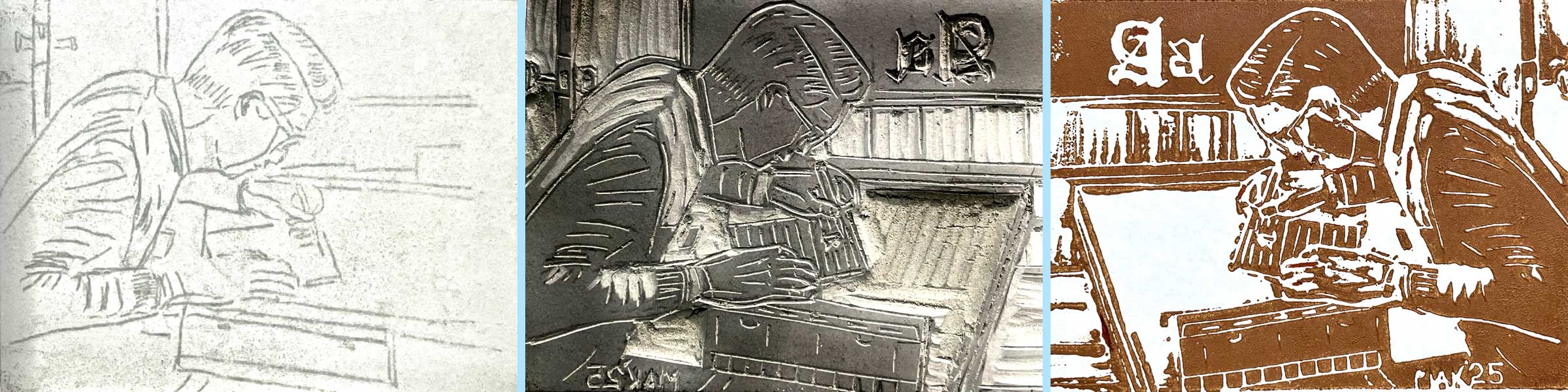
One of the most valuable classes I took, besides those in Science, Journalism, and Mathematics at Hunter College, Bronx, 1959, was Drafting. I wanted to visualize my memory about that time, so I decided to carve a linoleum block and make a print. This linoleum block is 4″ x 5″.
To try to understand the unknown, study a mirror.😉The ‘marks’ in the background are intended to be Old English calligraphy, a capital ‘A’, and a lower case ‘a’, written in chalk on a blackboard. They don’t become understandable until a person uses a mirror to look at the carving. The mirror is also useful to see how a print might turn out.
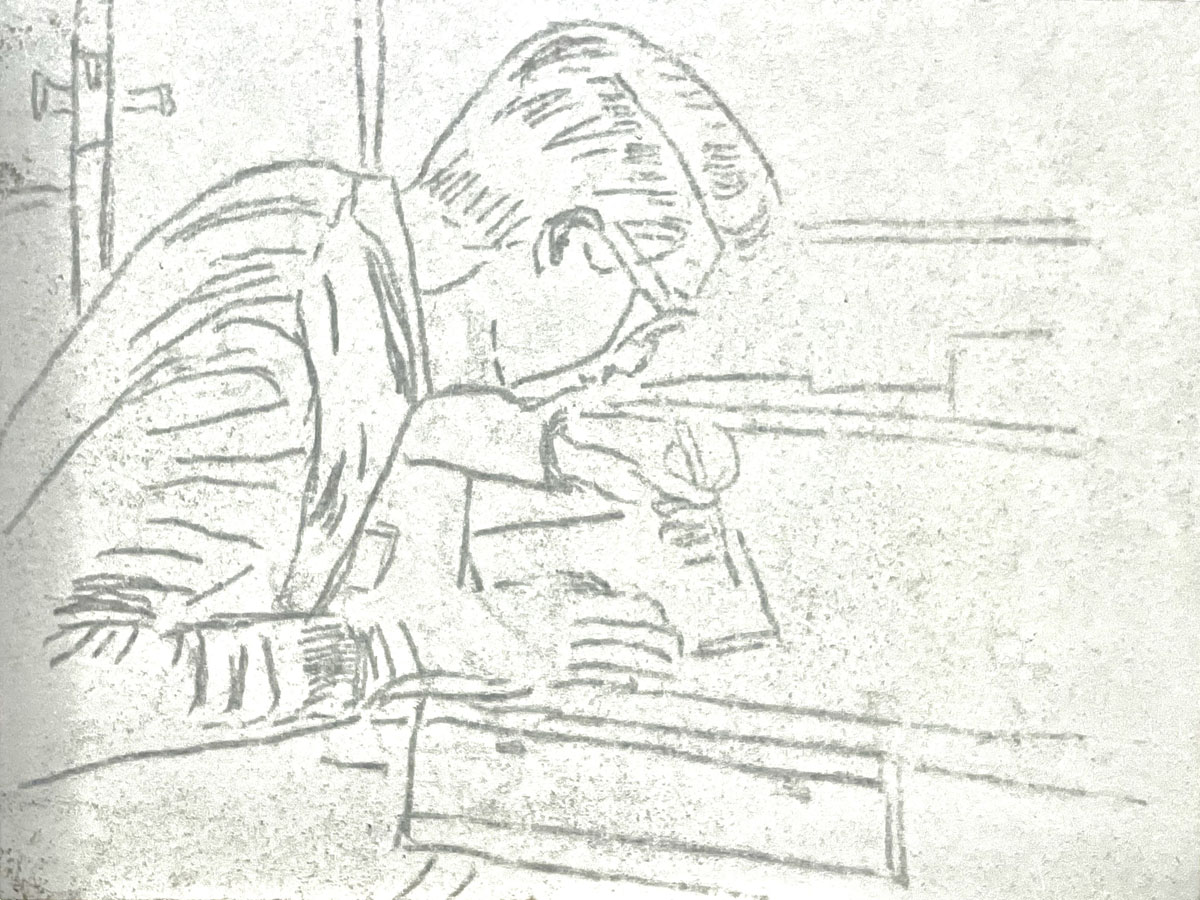
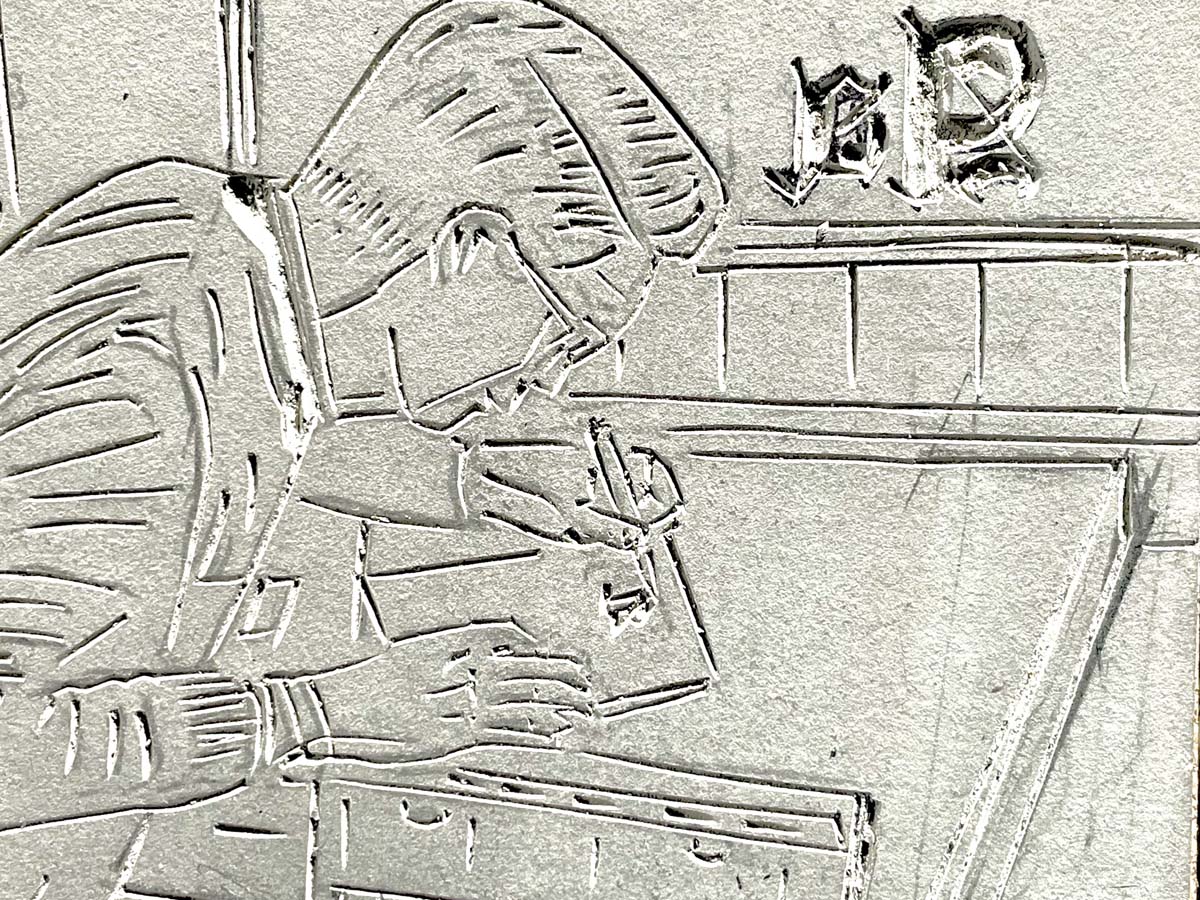
The carving lines are evident on the linoleum block, but the print will only show traces of them. Haven’t decided on lightening face and hands; might use light brown ink as an alternative to carving them.
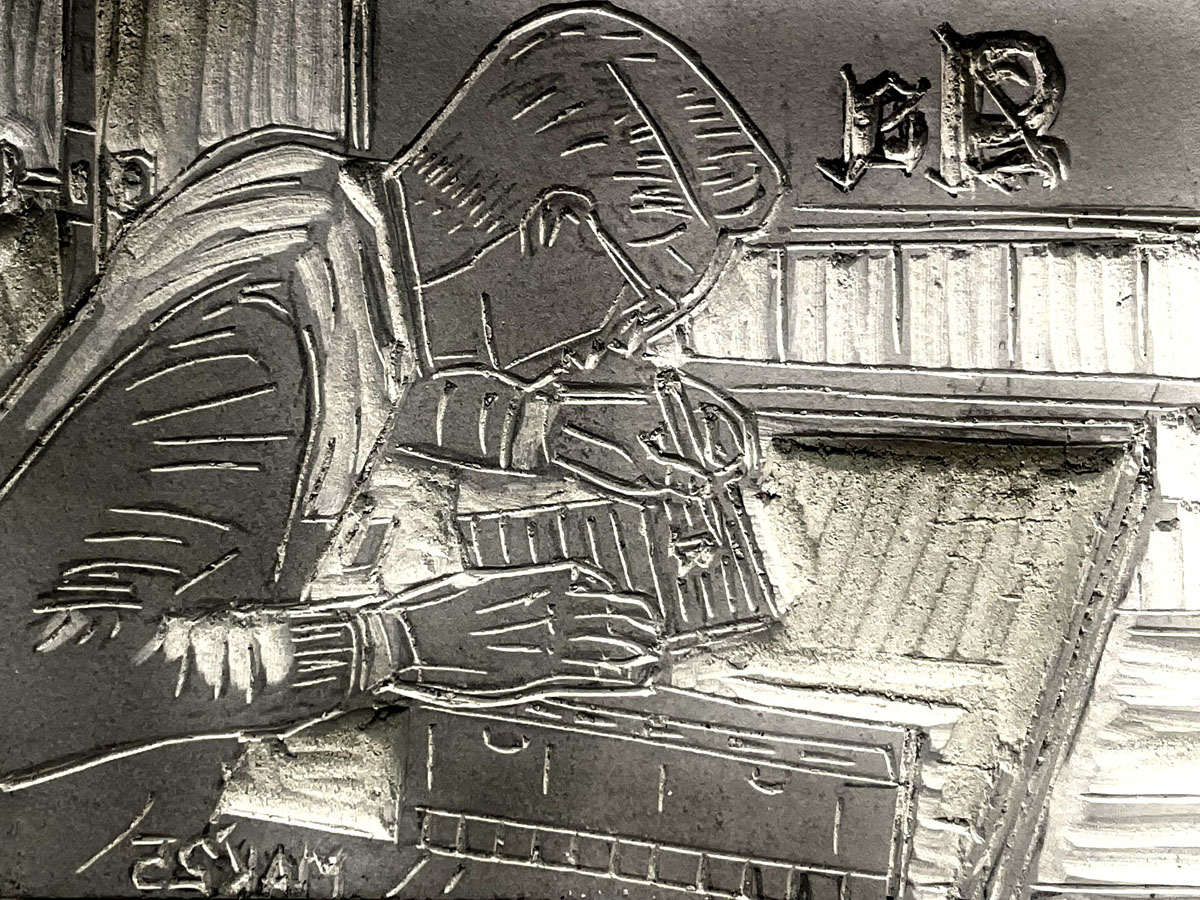
To show the methods that I’m using to give dimensionality to the face and hands in this carving, this closeup reveals the fine details on the rendered block.

The cuts are done with a rare #6 Speedball gouge; a wide, almost flat ‘spoon’ gouge.
The cheek is left ‘dark’, but the light falling on the face is done by very shallow carving. Instead of using finger pressure exerted on the paper upon the inked block, a baren supplying evenly distributed contact should give the effect that I’m looking for.
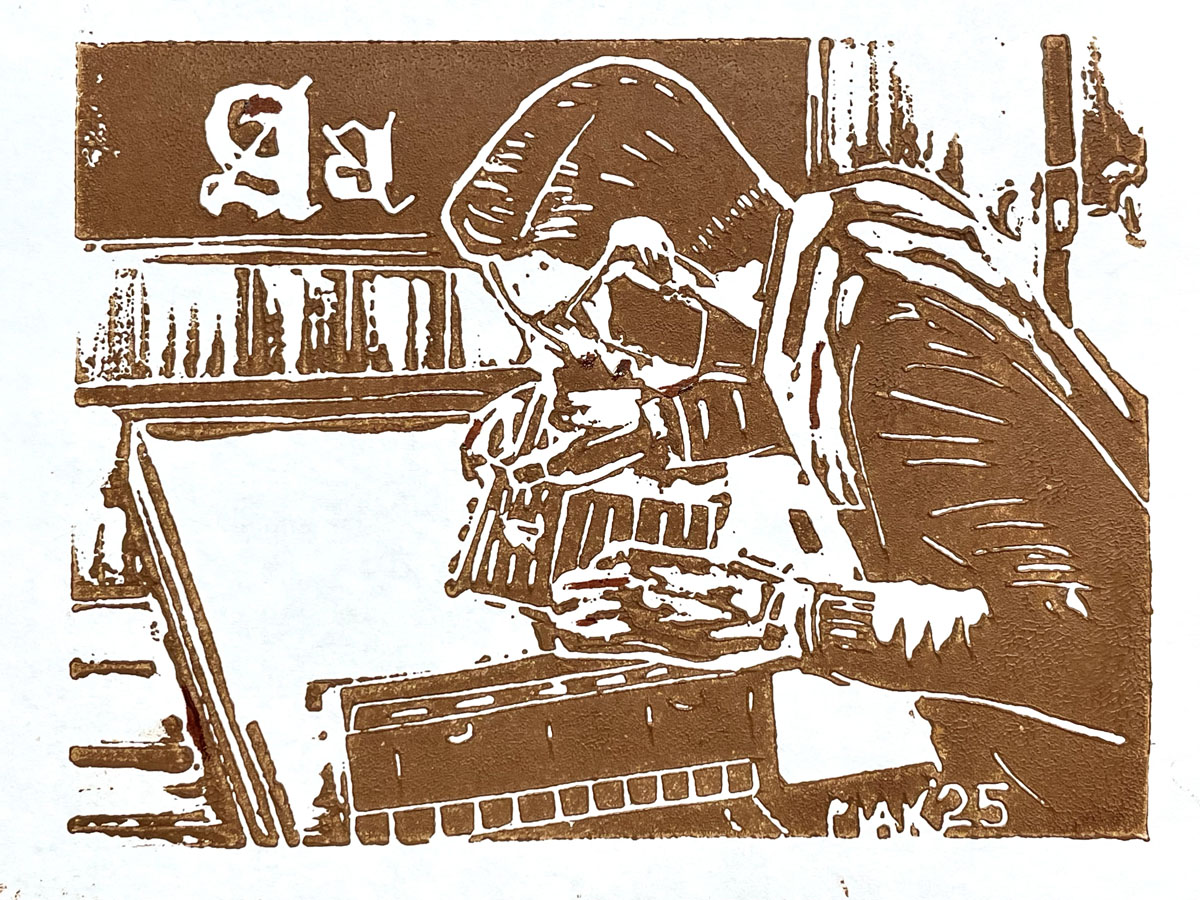
There are many variables involved in producing the desired print. After all that, every reproduction will still look unique! As you have seen in the progression from sketch to this final print, many techniques (and tools) have been employed to get to this stage.
My college Drafting course trained me to attempt ‘perfection’ with each stroke of a special pen. That skill became more useful when I started to do linoleum block carving, 11 years later. In this new hobby, special small carving ‘pen-tips’ are used to engrave fine lines or broad strokes to remove the linoleum. As the above images demonstrate, a negative is produced; material that is carved away will print as white (if white paper is used). Material that remains will print in the single color of ink that is chosen.
Drafting was a fundamental skill, that allowed me to develop the art form presented in this article.
If you liked the article, consider visiting Jordan’s gallery on our website.
Leave a Reply